
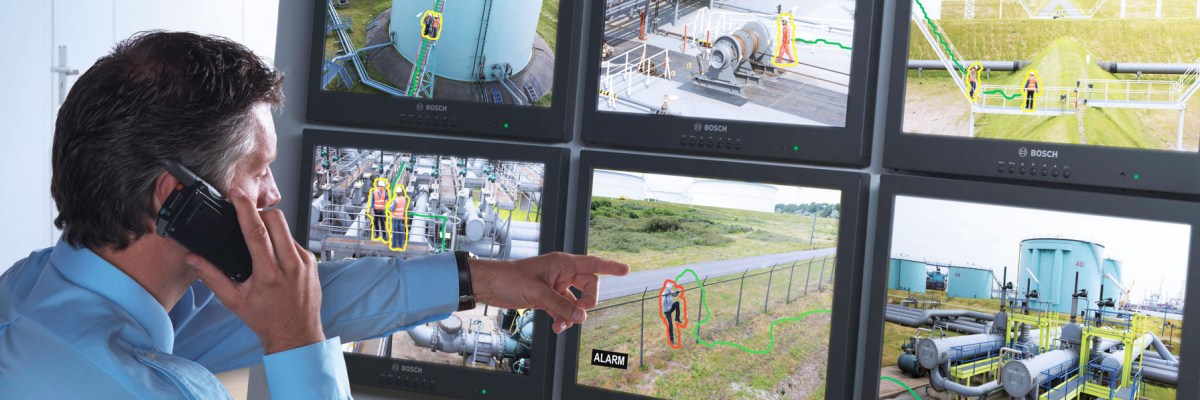
Most CCTV systems record everything and notice nothing. Operators cannot watch hundreds of screens, so incidents are found after the fact. AI video analytics changes that by turning cameras into sensors that flag what matters, as it happens. Security budgets in the Kingdom are rising faster than the regional average, and analytics is where much of that investment is going.
What AI analytics can do today
- People and vehicle detection that ignores shadows, animals and moving trees, cutting false alarms.
- Perimeter and line-crossing alerts for fences, gates and restricted zones.
- Loitering and unattended-object detection in lobbies, car parks and public areas.
- Licence-plate recognition (LPR) for gates, car parks and visitor management.
- Forensic search: find every red vehicle or person in a given area across hours of footage in seconds.
- Counting and occupancy to understand how spaces are used.
How to specify it well
- Start from use cases, not features. List the incidents you need to prevent or detect, site by site.
- Get the cameras right. Analytics only works with the right resolution, angle, lighting and lens for each use case.
- Choose where the processing runs. Edge analytics in the camera reduces bandwidth; server analytics offers more power and central management.
- Pilot before you scale. Test accuracy on your own sites, in your own conditions, including heat, dust and night-time.
- Integrate. Alerts should reach the command centre alongside access control and alarms, with a clear response procedure for each.
- Stay compliant. Design within the Saudi surveillance camera law, including its prohibited areas and rules on recordings.
Radees delivers AI-powered video surveillance and unified command centres for government, telecom, healthcare and commercial sites. See our video surveillance solutions or talk to our team.